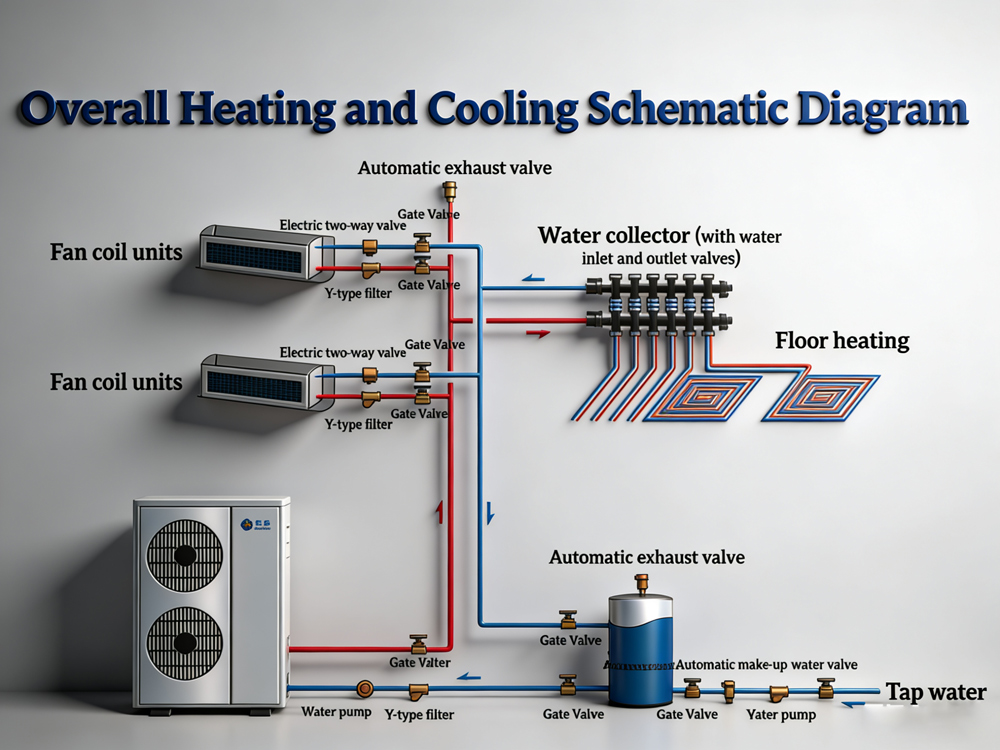
As outlined in the Energy Saving Trust’s official guidance, air source heat pumps (ASHP) are not one-size-fits-all solutions. Beyond the classic monobloc and split systems that dominate residential markets, today’s ASHP ecosystem has evolved into a diverse family of specialized units, tailored for every use case from home heating to commercial drying, ultra-cold climate operation, and industrial hot water production.
The foundational split: monobloc vs. split systems
At the residential core, the Energy Saving Trust defines two primary configurations that remain the backbone of domestic installations:
Monobloc systems: All core components are housed in a single outdoor unit, with only water pipes connecting to the home’s central heating and hot water cylinder. These plug-and-play units are ideal for compact properties, requiring minimal indoor installation space, though they trade a small degree of efficiency for simplicity.
At the residential core, the Energy Saving Trust defines two primary configurations that remain the backbone of domestic installations:
Monobloc systems: All core components are housed in a single outdoor unit, with only water pipes connecting to the home’s central heating and hot water cylinder. These plug-and-play units are ideal for compact properties, requiring minimal indoor installation space, though they trade a small degree of efficiency for simplicity.
Split systems: These separate the heat pump into indoor and outdoor units, with heat transfer partially occurring inside the building’s warmer environment to reduce energy loss. This design delivers slightly higher efficiency, making them popular for larger, better-insulated homes seeking maximum performance.
Beyond these basics, modern ASHP innovation has spawned specialized variants to meet evolving market demands:
Ultra-Low-Temperature Variable Frequency Heat Pump Units: Breaking cold climate barriers
For regions where sub-zero temperatures once rendered air source heat pumps ineffective, Ultra-Low-Temperature Variable Frequency Heat Pump Units have redefined operational limits. Powered by advanced variable frequency drive (VFD) technology, these units maintain stable heating performance even in extreme conditions—some models operating reliably at temperatures as low as -35°C. Unlike fixed-speed units that struggle with defrost cycles and efficiency drops in cold weather, variable frequency compressors adjust output dynamically to match heating demand, delivering consistent warmth while slashing energy consumption by up to 30% compared to traditional alternatives. This has made them a game-changer for decarbonization efforts in Northern Europe, North America, and high-altitude Asian markets, where winter temperatures once limited renewable heating adoption.
Beyond these basics, modern ASHP innovation has spawned specialized variants to meet evolving market demands:
Ultra-Low-Temperature Variable Frequency Heat Pump Units: Breaking cold climate barriers
For regions where sub-zero temperatures once rendered air source heat pumps ineffective, Ultra-Low-Temperature Variable Frequency Heat Pump Units have redefined operational limits. Powered by advanced variable frequency drive (VFD) technology, these units maintain stable heating performance even in extreme conditions—some models operating reliably at temperatures as low as -35°C. Unlike fixed-speed units that struggle with defrost cycles and efficiency drops in cold weather, variable frequency compressors adjust output dynamically to match heating demand, delivering consistent warmth while slashing energy consumption by up to 30% compared to traditional alternatives. This has made them a game-changer for decarbonization efforts in Northern Europe, North America, and high-altitude Asian markets, where winter temperatures once limited renewable heating adoption.
Variable Frequency Heat Pump Water Heaters & Air Source Heat Pump Hot Water Systems: Domestic and commercial hot water reimagined
Hot water production is one of the most common applications of air source heat pumps, with two leading categories dominating the space:
Variable Frequency Heat Pump Water Heaters: Designed for standalone domestic use, these compact units pair variable frequency compressors with insulated hot water cylinders, delivering efficient, on-demand hot water while avoiding the energy waste of constant cycling. Unlike traditional electric water heaters that convert 1kWh of electricity into just 1kWh of heat, these units leverage the heat pump cycle to deliver 3-4kWh of heat for every 1kWh of electricity consumed, cutting household water heating costs by up to 75%.
Air Source Heat Pump Hot Water Systems: Scaled for multi-unit residential buildings, hotels, and small commercial facilities, these centralized systems integrate with building plumbing infrastructure to provide bulk hot water. Many models include smart controls that prioritize off-peak operation, reducing strain on the grid and further lowering operational costs for property managers.
Variable Frequency Heat Pump Water Heaters: Designed for standalone domestic use, these compact units pair variable frequency compressors with insulated hot water cylinders, delivering efficient, on-demand hot water while avoiding the energy waste of constant cycling. Unlike traditional electric water heaters that convert 1kWh of electricity into just 1kWh of heat, these units leverage the heat pump cycle to deliver 3-4kWh of heat for every 1kWh of electricity consumed, cutting household water heating costs by up to 75%.
Air Source Heat Pump Hot Water Systems: Scaled for multi-unit residential buildings, hotels, and small commercial facilities, these centralized systems integrate with building plumbing infrastructure to provide bulk hot water. Many models include smart controls that prioritize off-peak operation, reducing strain on the grid and further lowering operational costs for property managers.
High-Temperature Heat Pump Dryers: Industrial efficiency meets sustainability
In industrial and commercial drying applications, High-Temperature Heat Pump Dryers are replacing fossil fuel-powered dryers as a low-carbon alternative. Unlike standard ASHPs that operate at moderate temperatures, these specialized units produce process heat up to 80-120°C, making them suitable for food processing, pharmaceutical manufacturing, textile drying, and agricultural product dehydration. The technology recycles waste heat from the drying process, achieving Coefficients of Performance (COP) as high as 4.5, meaning they deliver 4.5 units of heat for every unit of electricity used. Market forecasts project the high-temperature heat pump dryer market will grow at a 3.2% CAGR through 2035, driven by global decarbonization regulations that penalize gas and oil-fired drying equipment.
In industrial and commercial drying applications, High-Temperature Heat Pump Dryers are replacing fossil fuel-powered dryers as a low-carbon alternative. Unlike standard ASHPs that operate at moderate temperatures, these specialized units produce process heat up to 80-120°C, making them suitable for food processing, pharmaceutical manufacturing, textile drying, and agricultural product dehydration. The technology recycles waste heat from the drying process, achieving Coefficients of Performance (COP) as high as 4.5, meaning they deliver 4.5 units of heat for every unit of electricity used. Market forecasts project the high-temperature heat pump dryer market will grow at a 3.2% CAGR through 2035, driven by global decarbonization regulations that penalize gas and oil-fired drying equipment.
Commercial Heat Pump Units: Scaling ASHP technology for large-scale applications
At the top end of the spectrum, Commercial Heat Pump Units are engineered to meet the heating, cooling, and hot water demands of offices, retail spaces, hospitals, and industrial facilities. These modular, high-capacity systems combine multiple heat pump modules to deliver scalable output, with advanced controls that optimize performance across varying load conditions. Many commercial units also offer dual heating and cooling functionality, serving as both a primary heating system in winter and an energy-efficient air conditioning solution in summer. Leading manufacturers are now launching rooftop-mounted commercial ASHP units that maintain full heating capacity at temperatures as low as -29°C, eliminating the need for backup fossil fuel boilers in even the coldest climates.
At the top end of the spectrum, Commercial Heat Pump Units are engineered to meet the heating, cooling, and hot water demands of offices, retail spaces, hospitals, and industrial facilities. These modular, high-capacity systems combine multiple heat pump modules to deliver scalable output, with advanced controls that optimize performance across varying load conditions. Many commercial units also offer dual heating and cooling functionality, serving as both a primary heating system in winter and an energy-efficient air conditioning solution in summer. Leading manufacturers are now launching rooftop-mounted commercial ASHP units that maintain full heating capacity at temperatures as low as -29°C, eliminating the need for backup fossil fuel boilers in even the coldest climates.
A market evolving to meet every need
The evolution of air source heat pumps—from basic monobloc/split systems to specialized high-temperature, ultra-low-temperature, and commercial units—reflects the industry’s push to make renewable heating viable for every context. As governments phase out fossil fuel heating incentives and tighten carbon emissions regulations, these specialized ASHP variants are poised to capture growing market share, proving that air source heat pumps are no longer just a residential solution, but a versatile workhorse for the entire energy transition.
The evolution of air source heat pumps—from basic monobloc/split systems to specialized high-temperature, ultra-low-temperature, and commercial units—reflects the industry’s push to make renewable heating viable for every context. As governments phase out fossil fuel heating incentives and tighten carbon emissions regulations, these specialized ASHP variants are poised to capture growing market share, proving that air source heat pumps are no longer just a residential solution, but a versatile workhorse for the entire energy transition.